Dr. Michael J. Lee
D R .

MICHAEL J. LEE

CLINICAL AND DEPTH PSYCHOLOGY

Psychotherapy for individuals and couples in Charlotte, with online care across PSYPACT-participating states.

REQUEST A CONSULTATION

Welcome

I am a licensed psychologist based in Charlotte, North Carolina.  I work with individuals and couples in my SouthPark-area office and online across NC and most of the United States via PSYPACT®.

I am drawn to this profession by the knowledge that thoughtful, well-supported inner work can change a person’s life. My practice is rooted in Jungian, psychoanalytic, and existential traditions, and stays in sustained conversation with contemporary behavioral, cognitive, and affective science. Beneath the different vocabularies, the questions remain the same: how the mind makes meaning, how patterns take hold in a life, and what makes real and lasting change possible.

I invite you to explore more about my approach and how therapy might support you—and to reach out if you are interested in working together. You can contact me via the link below or by email.

“Freedom is man’s capacity to take a hand in his own development.”—Rollo May

An Overview

People seek therapy for many important reasons. Sometimes, the problem is clear. At other times, it is harder to put into words. Something just feels stuck, incomplete, or more difficult than it should be. Whether you are facing a specific challenge or simply know that something in your life needs attention, choosing to engage in therapy means deciding that your experience is worth really understanding—and that you do not have to figure it all out on your own.

My approach to therapy is thoughtful and collaborative, guiding us to understand the roots and full nature of what you are going through—and how that fits into the larger picture of your life. Often, problems that feel confusing or overwhelming begin to make more sense when we take the time to look at them closely and in context. Even long-standing patterns can become clearer—understood not just for what they are, but for what might truly help. Such understanding can lead to new ways of handling what once felt unmanageable: more clarity, more steadiness, more choice.

This kind of work takes patience and care. But over time, it can help you feel more like yourself—creating the conditions for a fuller sense of well-being to emerge, perhaps in ways you have not yet had the freedom to experience.

“Who looks outside, dreams; who looks inside, awakes.”—C.G. Jung
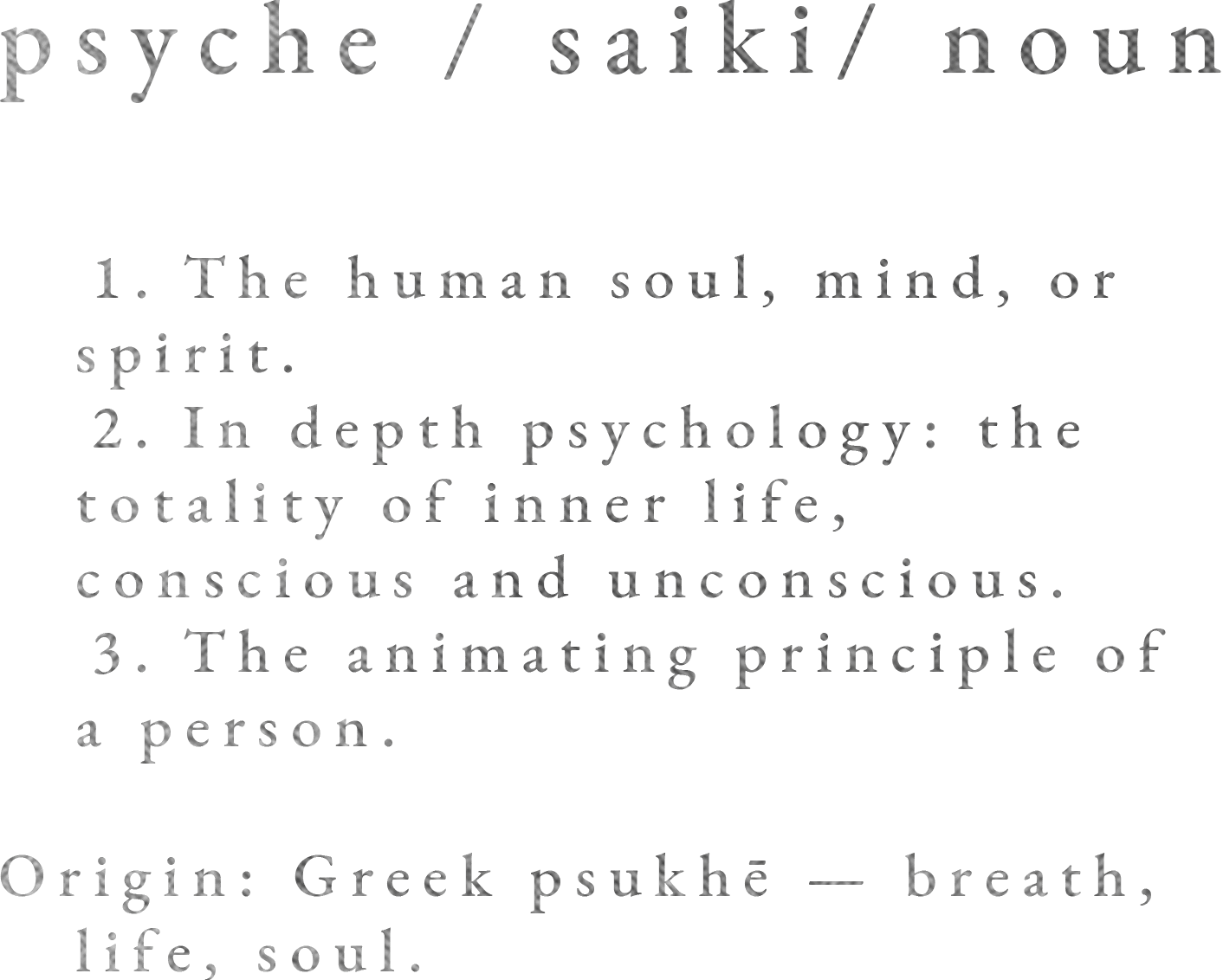
psyche / saiki/ noun.  1. The human soul, mind, or spirit.  2. In depth psychology: the totality of inner life, conscious and unconscious.  3. The animating principle of a person.  Origin: Greek psukhē — breath, life, soul.

Jungian and Depth Psychotherapy

Whatever brings someone to therapy, the work begins with what is most immediate and remains open to the larger life in which it has taken shape. A named problem—anxiety that will not loosen, a loss, or a pattern in relationships that keeps repeating—may lead toward a history, conflict, or way of making meaning not yet fully seen. A quieter restlessness, a dream that lingers, or a sense that something meaningful has gone missing may be asking for the same kind of attention. These are not separate paths. In each, something within is reaching—not to be silenced or corrected, but to be listened to, with care.

This depth-oriented way of working offers a space in which to turn toward—or deepen one’s relationship to—that inner life. Not to explain it away or reduce it to symptoms—but to listen. Beneath the surface of everyday thought, the psyche speaks in images, emotions, and patterns that may not always be logical, but are deeply meaningful. This work is about learning to hear and speak that language—to trace the forces that have shaped you, to reconnect with forgotten parts of yourself, and to begin living from a deeper, more honest place.

This is not a quick path. It is a kind of homecoming—slow, intimate, and often surprising. It asks for patience, presence, and a willingness to follow what may not make sense at first. But those who engage with this work often find that what once felt confusing or painful begins to feel meaningful, even necessary. That there is wisdom in the struggle. That the life waiting to be lived is more one’s own.

Among the richest ways the inner life opens up is through dreams…

Explore Dreams

Every night, a curtain rises within you. Without script or rehearsal, the psyche stages a drama—rich in image, mood, and meaning. Something deep within you plays out in symbolic form. This is the dream: not nonsense, not noise, but a kind of personal theater where your inner life speaks in its native tongue.

It helps to approach dreams as performances to be witnessed, nuanced scenes to be explored. Each dream is an invitation to sit quietly in the audience of your own unconscious and attend to what takes the stage. The angry child, the forgotten house, the rising water, the animal at the edge of the frame—all are parts of you, wearing costumes, speaking in metaphor, trying to be seen.

By returning to your dreams with care and curiosity, we begin to ask: Who is showing up here? What is the emotional tone of the scene? What is being acted out that I might not be fully aware of in waking life? In this way, dream analysis becomes less about decoding and more about entering into a relationship—with the story your psyche is telling, with the characters it casts, and with the parts of yourself it is trying to bring into the light.

Over time, attending to this inner theater helps cultivate what C.G. Jung called a symbolic attitude—a way of seeing your inner world not as a problem to fix, but as a meaningful drama unfolding. The more you learn to sit with these stories, the more you may find yourself changed by them—gaining insight, healing old wounds, and discovering new roles you did not know you were allowed to play.

See Yourself Clearly

The curtain does not fall when you wake up. The inner theater continues—less overtly symbolic perhaps, but just as alive. Scenes play out in your reactions, your relationships, your moods. Certain roles appear again and again: the one who withdraws, the one who pleases, the one who yearns, the one who attacks, the one who fears, the one who offers, the one who demands. Often, they arrive so quickly and so convincingly that you hardly notice the shift has happened. One moment you are yourself; the next, you are caught in a role you did not consciously choose.

In depth therapy, we begin to pay attention to these performances—not to judge or suppress them, but to understand them. We start to get to know the cast of characters within you. Each one carries a history. Each learned its role for a reason. Some stepped in to protect you. Others to keep you connected. Still others carry the ache of hurts that have never known care or understanding. Many might still be rehearsing scenes from long ago, hoping for a different ending.

The aim is to bring what has been automatic into awareness—so that you are less swept up by old roles and more able to respond with clarity and care. As you begin to see yourself more clearly, the same patterns no longer have to play out in the same way. You become less entangled in reactions you did not fully understand—and more able to choose how you want to live.

Support Your Own Growth

Growth in this work means participating in your own development—noticing what remains unresolved, staying with what feels divided, and allowing your understanding of yourself to deepen and expand. It is not a project of self-perfection, and it does not ask you to become someone else.

Supporting your own growth means learning to take in experience in ways that let it be felt, reflected on, and integrated. This often involves facing contradictions: between who you have been and who you are becoming, between inherited expectations and emerging values, between what once protected you and what now constrains you.

This kind of growth is gradual—its movements often visible only in retrospect. It requires patience, honesty, and a willingness to remain in conversation with what is unfolding. But over time, the psyche begins to hold more. What was once cut off can be rejoined. What once felt out of place starts to belong. One’s life begins to grow—not by force, but by the slow work of integration.

In this way, therapy becomes a place where development resumes—movement both inward and forward, unfolding as a more deeply inhabited life. And the inner theater changes with you: old scenes lose their grip, new roles open, and what was long rehearsed may finally find a different ending.

“Who looks outside, dreams; who looks inside, awakes.”—C.G. Jung
psyche / saiki/ noun.  1. The human soul, mind, or spirit.  2. In depth psychology: the totality of inner life, conscious and unconscious.  3. The animating principle of a person.  Origin: Greek psukhē — breath, life, soul.

Jungian and Depth Psychotherapy

Whatever brings someone to therapy, the work begins with what is most immediate and remains open to the larger life in which it has taken shape. A named problem—anxiety that will not loosen, a loss, or a pattern in relationships that keeps repeating—may lead toward a history, conflict, or way of making meaning not yet fully seen. A quieter restlessness, a dream that lingers, or a sense that something meaningful has gone missing may be asking for the same kind of attention. These are not separate paths. In each, something within is reaching—not to be silenced or corrected, but to be listened to, with care.

This depth-oriented way of working offers a space in which to turn toward—or deepen one’s relationship to—that inner life. Not to explain it away or reduce it to symptoms—but to listen. Beneath the surface of everyday thought, the psyche speaks in images, emotions, and patterns that may not always be logical, but are deeply meaningful. This work is about learning to hear and speak that language—to trace the forces that have shaped you, to reconnect with forgotten parts of yourself, and to begin living from a deeper, more honest place.

This is not a quick path. It is a kind of homecoming—slow, intimate, and often surprising. It asks for patience, presence, and a willingness to follow what may not make sense at first. But those who engage with this work often find that what once felt confusing or painful begins to feel meaningful, even necessary. That there is wisdom in the struggle. That the life waiting to be lived is more one’s own.

Among the richest ways the inner life opens up is through dreams…

Explore Dreams

Every night, a curtain rises within you. Without script or rehearsal, the psyche stages a drama—rich in image, mood, and meaning. Something deep within you plays out in symbolic form. This is the dream: not nonsense, not noise, but a kind of personal theater where your inner life speaks in its native tongue.

It helps to approach dreams as performances to be witnessed, nuanced scenes to be explored. Each dream is an invitation to sit quietly in the audience of your own unconscious and attend to what takes the stage. The angry child, the forgotten house, the rising water, the animal at the edge of the frame—all are parts of you, wearing costumes, speaking in metaphor, trying to be seen.

By returning to your dreams with care and curiosity, we begin to ask: Who is showing up here? What is the emotional tone of the scene? What is being acted out that I might not be fully aware of in waking life? In this way, dream analysis becomes less about decoding and more about entering into a relationship—with the story your psyche is telling, with the characters it casts, and with the parts of yourself it is trying to bring into the light.

Over time, attending to this inner theater helps cultivate what C.G. Jung called a symbolic attitude—a way of seeing your inner world not as a problem to fix, but as a meaningful drama unfolding. The more you learn to sit with these stories, the more you may find yourself changed by them—gaining insight, healing old wounds, and discovering new roles you did not know you were allowed to play.

See Yourself Clearly

The curtain does not fall when you wake up. The inner theater continues—less overtly symbolic perhaps, but just as alive. Scenes play out in your reactions, your relationships, your moods. Certain roles appear again and again: the one who withdraws, the one who pleases, the one who yearns, the one who attacks, the one who fears, the one who offers, the one who demands. Often, they arrive so quickly and so convincingly that you hardly notice the shift has happened. One moment you are yourself; the next, you are caught in a role you did not consciously choose.

In depth therapy, we begin to pay attention to these performances—not to judge or suppress them, but to understand them. We start to get to know the cast of characters within you. Each one carries a history. Each learned its role for a reason. Some stepped in to protect you. Others to keep you connected. Still others carry the ache of hurts that have never known care or understanding. Many might still be rehearsing scenes from long ago, hoping for a different ending.

The aim is to bring what has been automatic into awareness—so that you are less swept up by old roles and more able to respond with clarity and care. As you begin to see yourself more clearly, the same patterns no longer have to play out in the same way. You become less entangled in reactions you did not fully understand—and more able to choose how you want to live.

Support Your Own Growth

Growth in this work means participating in your own development—noticing what remains unresolved, staying with what feels divided, and allowing your understanding of yourself to deepen and expand. It is not a project of self-perfection, and it does not ask you to become someone else.

Supporting your own growth means learning to take in experience in ways that let it be felt, reflected on, and integrated. This often involves facing contradictions: between who you have been and who you are becoming, between inherited expectations and emerging values, between what once protected you and what now constrains you.

This kind of growth is gradual—its movements often visible only in retrospect. It requires patience, honesty, and a willingness to remain in conversation with what is unfolding. But over time, the psyche begins to hold more. What was once cut off can be rejoined. What once felt out of place starts to belong. One’s life begins to grow—not by force, but by the slow work of integration.

In this way, therapy becomes a place where development resumes—movement both inward and forward, unfolding as a more deeply inhabited life. And the inner theater changes with you: old scenes lose their grip, new roles open, and what was long rehearsed may finally find a different ending.

“Baby, we can make it if we’re heart to heart.”—Starship
Formative Influences

I have always been drawn to weaving things together—curious how seemingly disparate ideas might speak to one another. Undergraduate courses in neuroscience fed my fascination with the brain and mind, bringing the study of consciousness alive as both a philosophical and scientific endeavor. Studying cinema and storytelling immersed me in Joseph Campbell’s work on mythic and archetypal patterns—patterns that shape our individual lives as much as the stories told across time and culture. Tracing Campbell’s inspirations became my first real entrée into depth psychology, and lectures in narrative medicine revealed how the stories we inherit and tell ourselves configure our understanding of suffering and selfhood.

What emerged was not a collection of interests but a coalescing sense of direction. I came to see that the questions I cared about were alive in the work of helping others: making sense of experience, staying present to what hurts, and finding the meaning that can emerge even in hardship.

That sense of vocation led me to doctoral training in clinical psychology, in a program with a formal emphasis in Couple and Family Psychology. There, I learned to apply systems and complexity frameworks to individual, interpersonal, and organizational concerns—attuning not only to what happens within a person but to the patterned dynamics that take shape between people and across time. That foundation still informs how I work.

That weaving of ideas has continued ever since. I value the community I have found training within the C.G. Jung Institute of New England, where I continue to deepen my study of depth psychology and the practice of Jungian analysis. My engagement with colleagues there, and through the other professional societies I belong to, carries into this work a sense of shared discovery and mutual purpose.

Joseph Campbell, whose writing once helped set me on this course, suggested that any transformative journey is incomplete without a return—bringing back, for the sake of others, what was found along the way. That is how I see my role: not as the expert above, but as a fellow traveler who has heard from those on the frontiers, gained a studied map of much of the territory, and grown practiced in helping others navigate its inevitable and varied passages.

Education

Bachelor of Arts in Cinematic Arts

University of Southern California

Master of Arts in Psychology

Pepperdine University

Doctor of Psychology in Clinical Psychology

Azusa Pacific University

programmatic emphasis in Couple and Family Psychology

concentration in Consulting Psychology

Professional Affiliations

American Psychological Association

Society for Couple and Family Psychology

Society for Psychoanalysis and Psychoanalytic Psychology

Society for Theoretical and Philosophical Psychology

Association for Contextual Behavioral Science

Credentialed by the National Register of Health Service Psychologists
More About My Therapeutic Approaches

(external links)

Online Practice

Through PSYPACT® and the Authority to Practice Interjurisdictional Telepsychology (APIT®), I am able to reach clients living in or traveling to most of the US. For details, view the official PSYPACT map linked below.

GETTING IN TOUCH

This secure form is for initial contact. You do not need to include personal or sensitive details here—please share your name, contact information, and, if you wish, a brief note about what brings you to therapy. We can speak about anything further once we have arranged a time to talk.

Your information will be encrypted.
Call the world if you please, ‘The vale of Soul-making.’ Then you will find out the use of the world.—John Keats

© 2026 Michael J. Lee. All rights reserved.